ArenaNet
One repository, one command, and you have a network that scales itself. The game on it, Core Siege, is my own: two to four teams defend a core, gather resources, buy upgrades and fight in a shrinking zone.
Download the compose bundle Source code All downloads Try it live
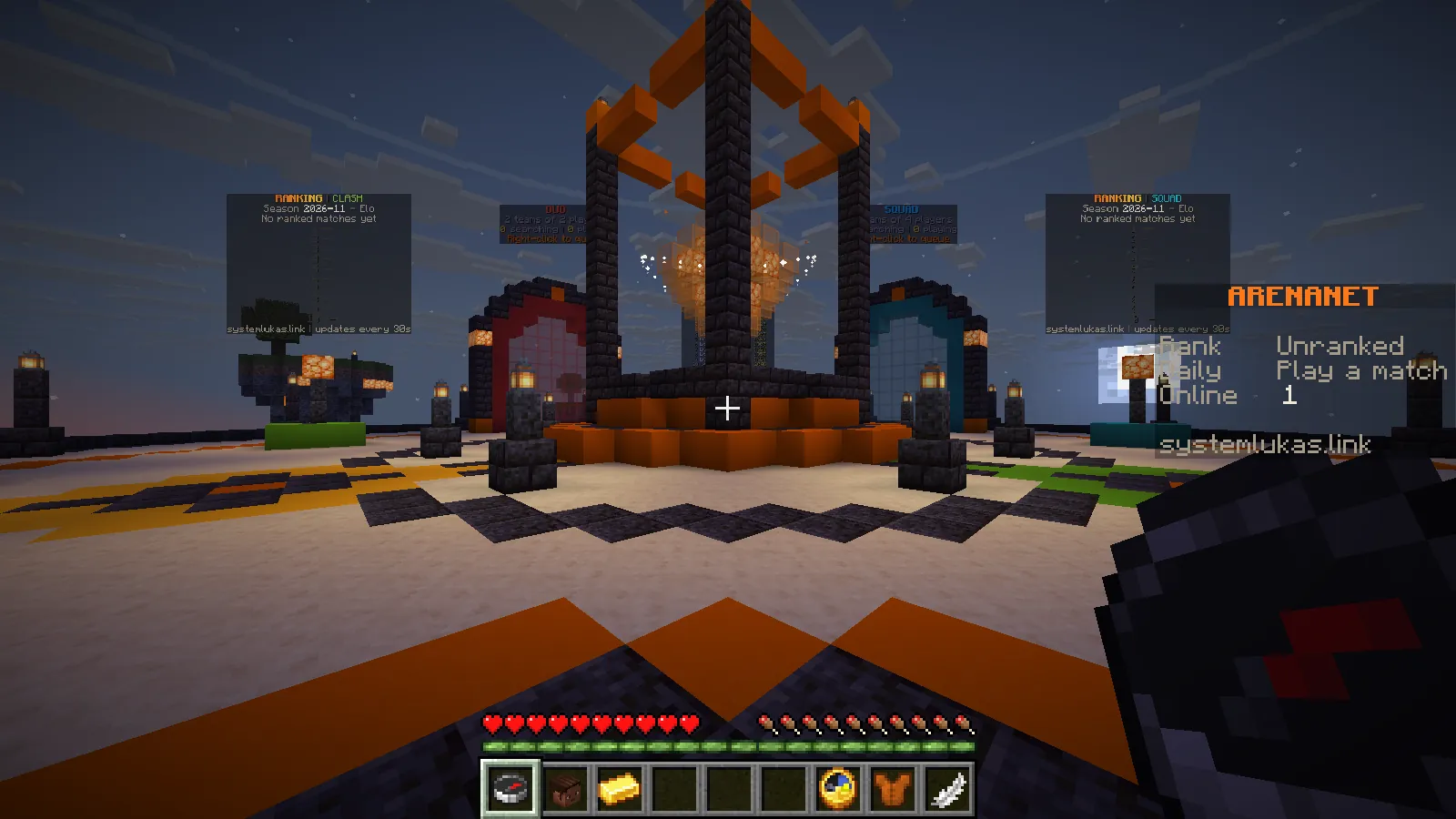
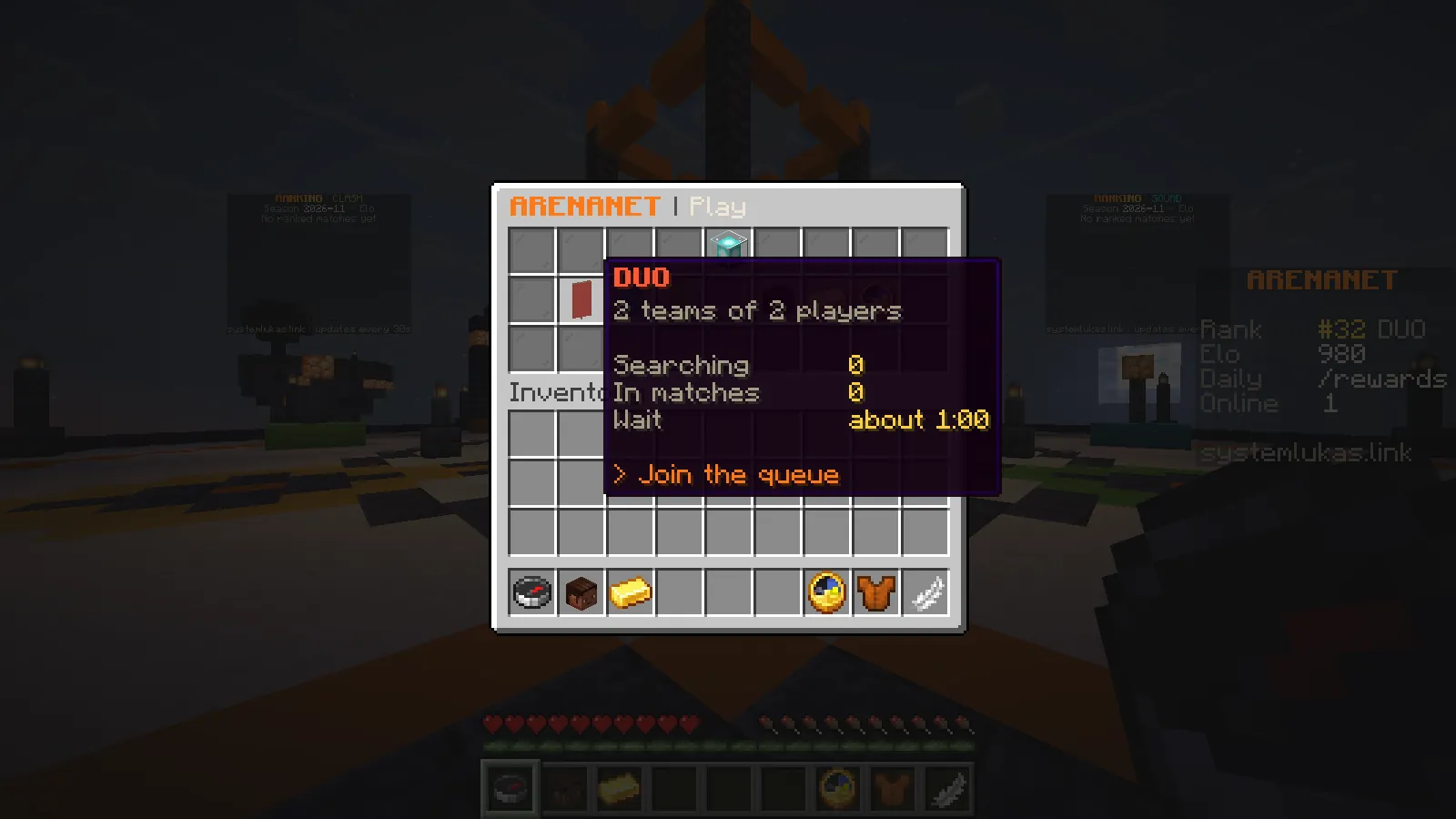
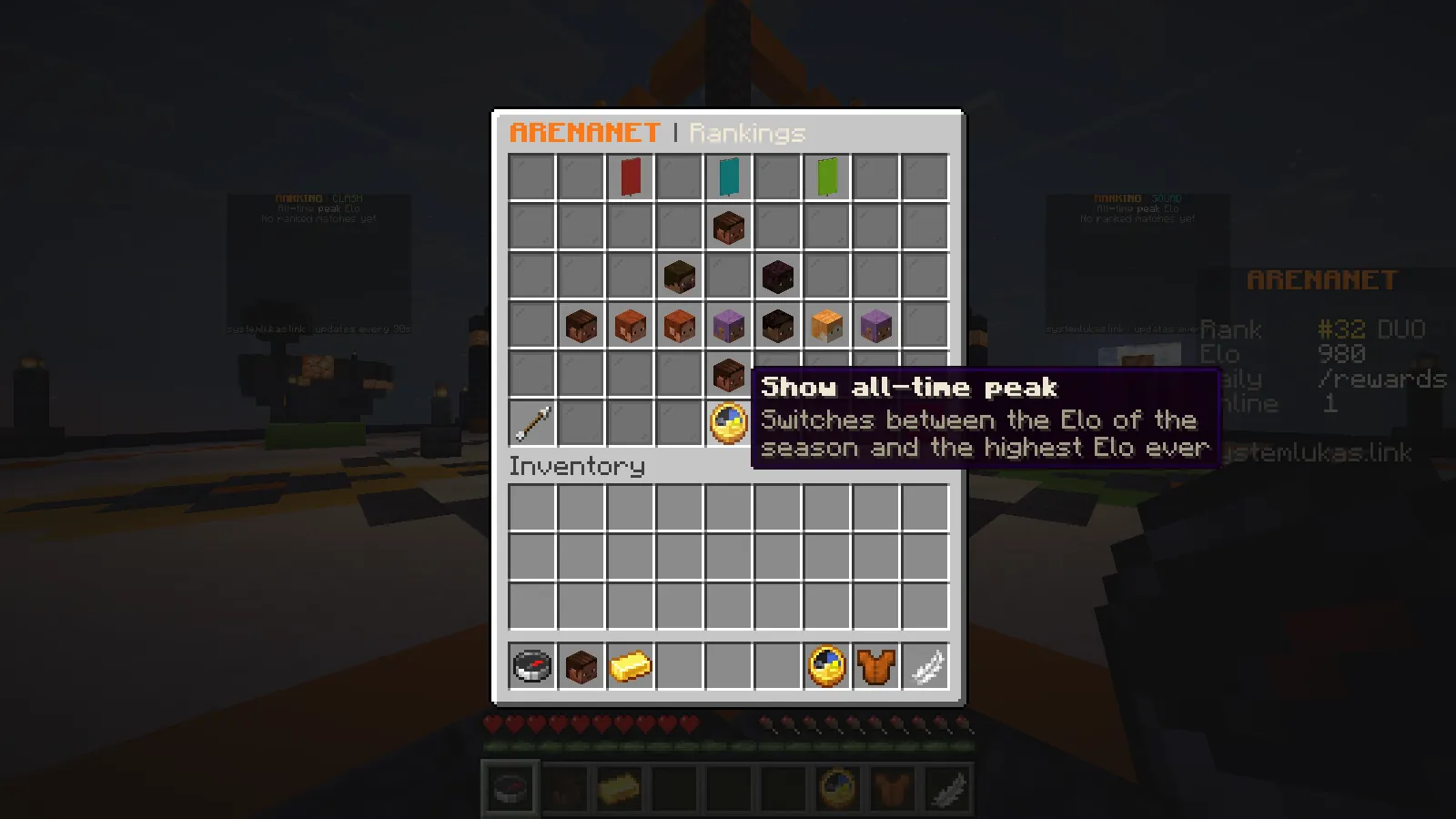
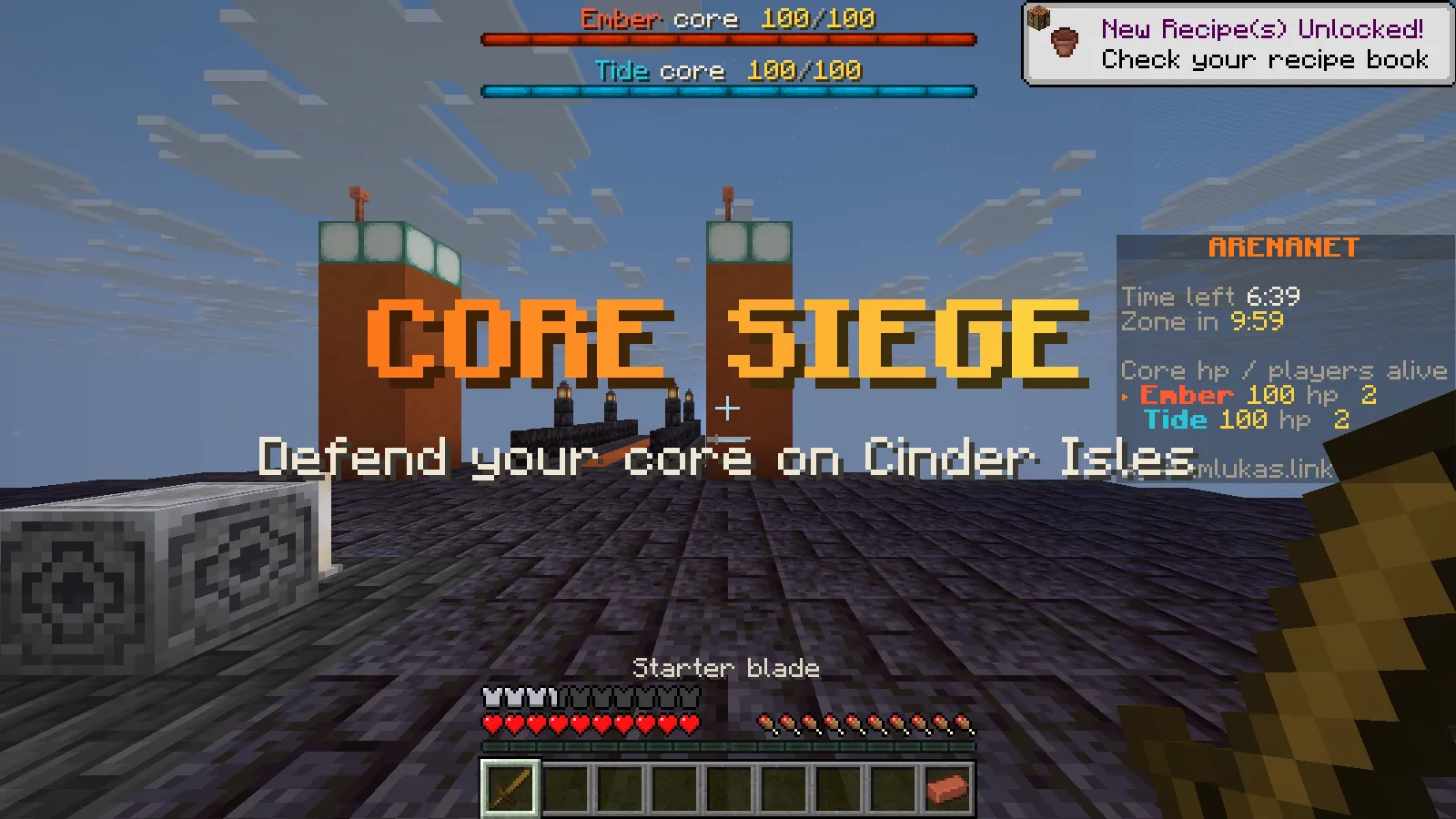
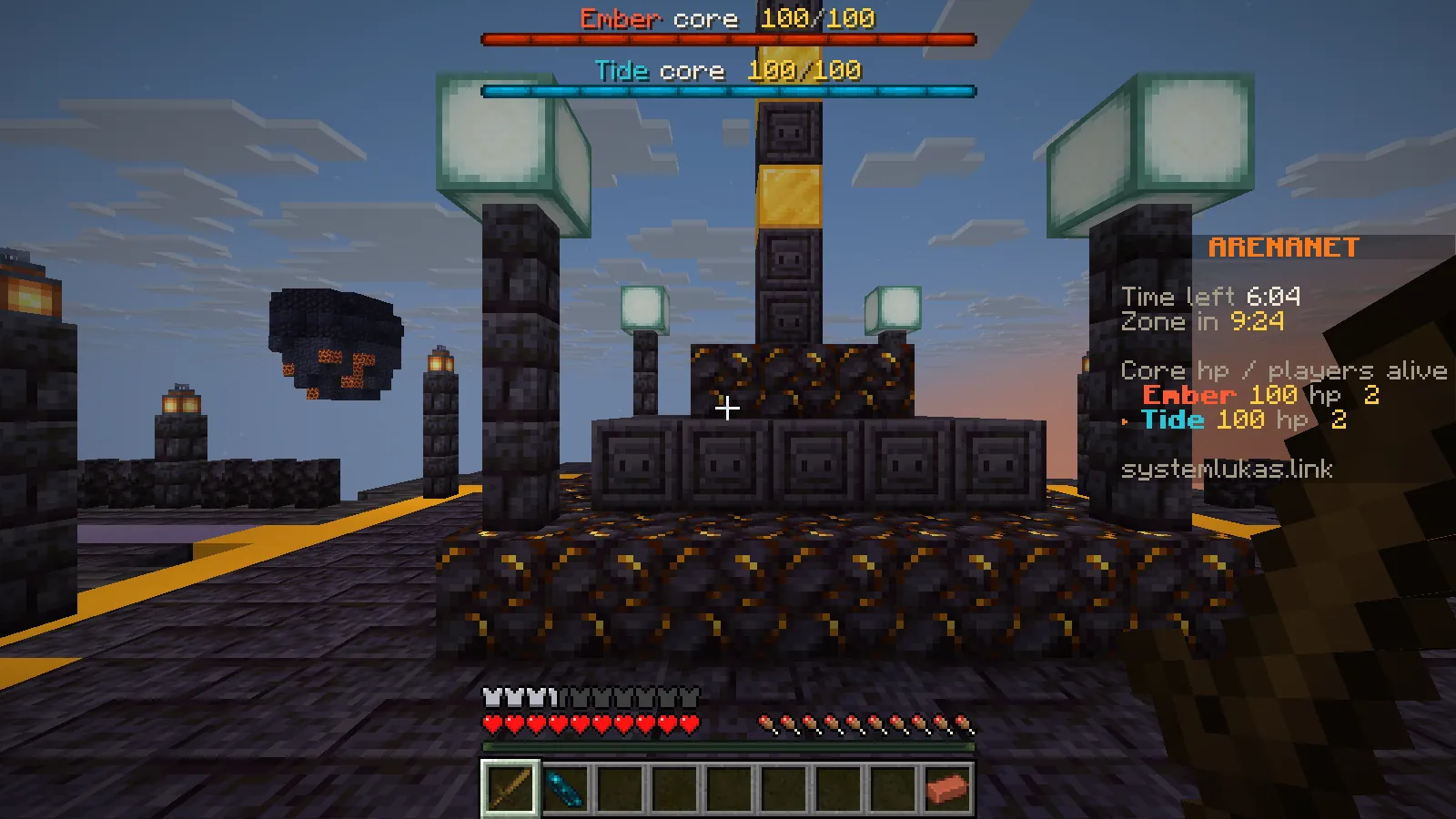
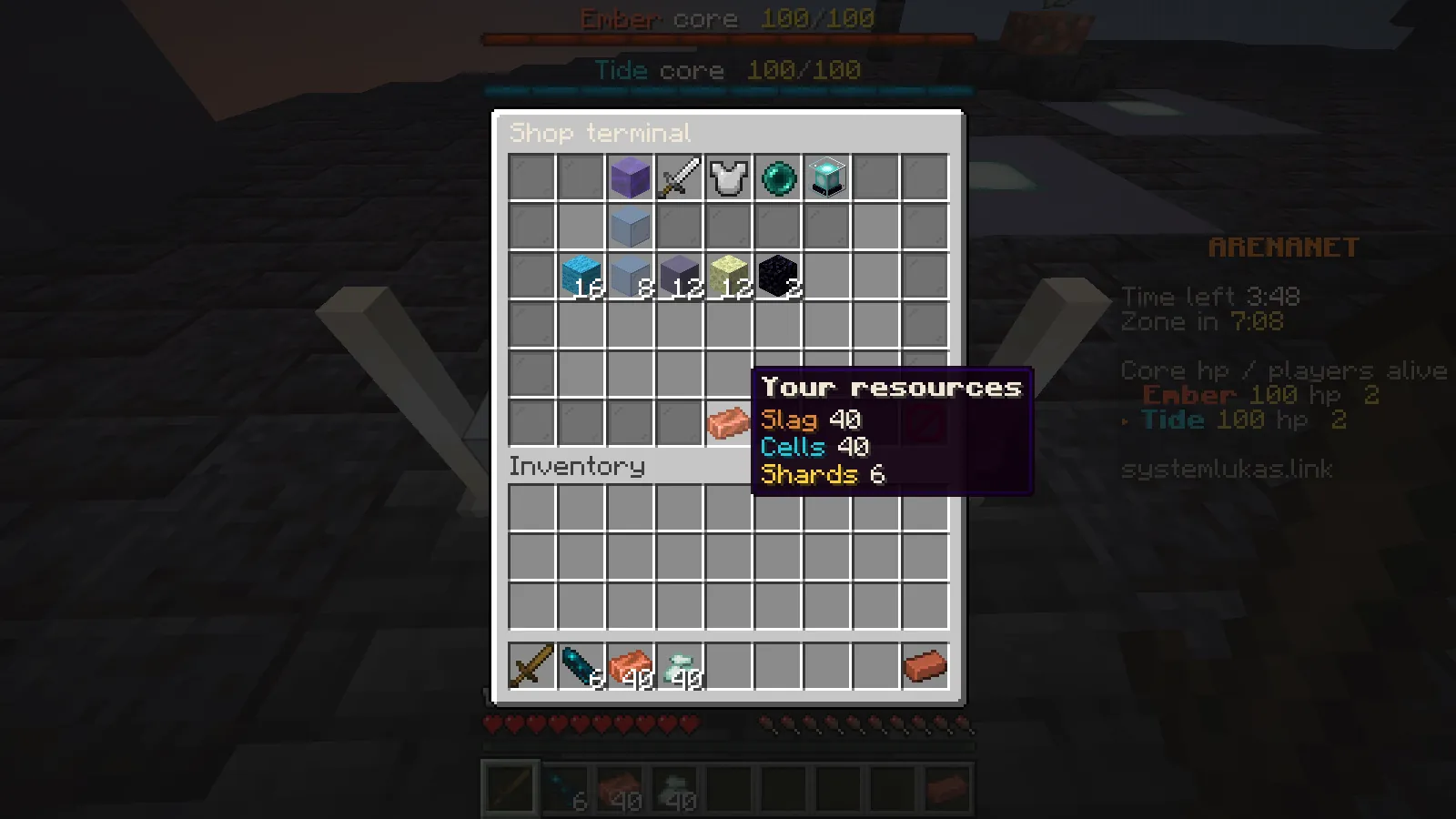
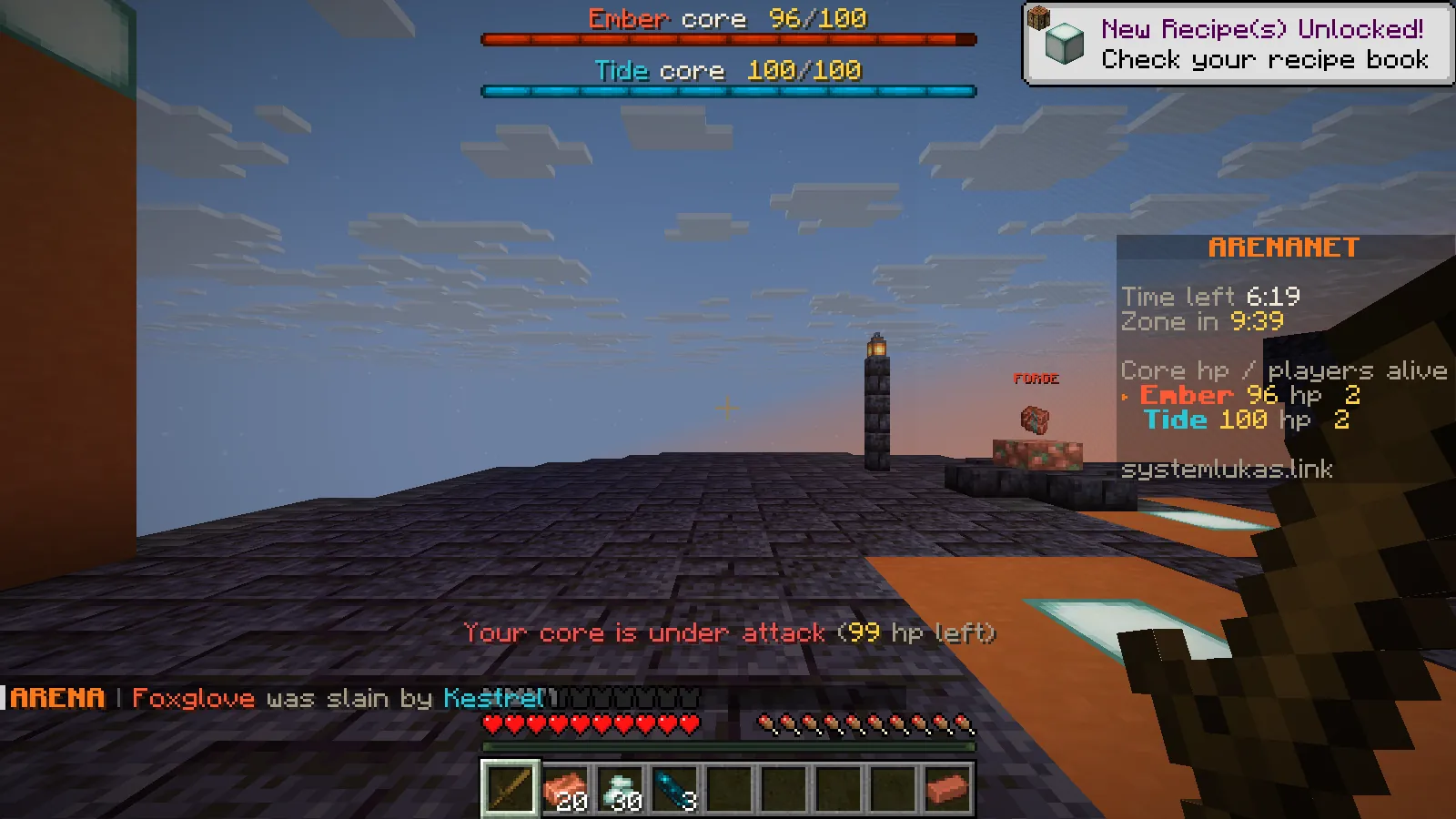
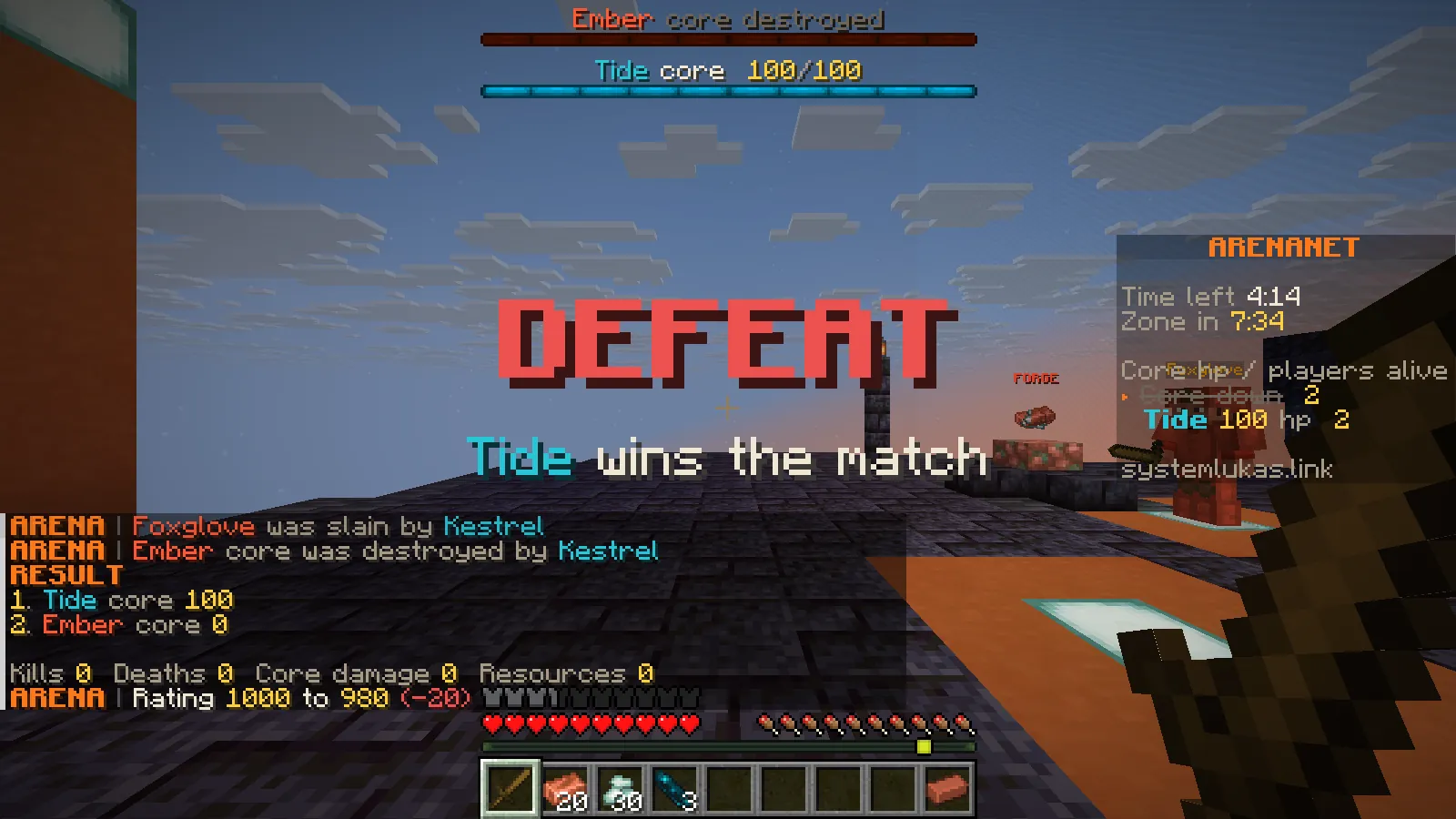
An image sequence from a real Minecraft 1.21.10 client, recorded headless on the test stack with demo data.
- 1,400+
- automated tests
- 40
- bots playing real matches
- 553
- matches per hour recorded
- 2 → 4
- arenas, scaled by the queue
Try it live.
A public test server runs my plugins for real: StreakRewards, StaffPanel, Fortuna and ServerBridge in the lobby, and the ArenaNet network with Core Siege behind it. Join with a normal Java client. No whitelist, no registration, no cost.
demo.systemlukas.link
- 1.21.10
- Minecraft Java Edition (1.21.9 works too)
- 40
- players at most
- 2
- arenas at most, started and stopped by the queue
- 04:00
- nightly reset, Berlin time
What you can test
StreakRewards
Talk to the librarian in the lobby, then type /rewards. A reward day lasts five minutes in the demo (or type /demo nextday), so you can watch a streak grow within one visit.
StaffPanel
Type /panel in the lobby. The whole admin panel opens against made-up players: ban, freeze, look into inventories and work through reports without touching anyone real. A new report arrives after half a minute.
Fortuna
Type /crate free for a key, then right-click a crate in the lobby: a roulette, a wheel or an instant opening, and the odds of every reward on a left click. Buy tickets with /lottery for demo coins; a draw with the staged ceremony runs every ten minutes. Demo coins have no value and cannot be traded.
ServerBridge
The dashboard of this server is public and read-only: status, arenas, matches and rankings, live. It updates while you play.
ArenaNet and Core Siege
Walk into a coloured gate to join the queue. A match needs two players, so bring a friend or wait for another visitor. When the first arena is busy, the orchestrator starts a second one.
The lobby
Rankings above the plaza, a parkour at the west gate, a double jump and a party menu. Five guides explain each plugin and link to its page.
House rules
- Be friendly. No cheats or hacked clients, no spam, no advertising.
- The chat is filtered and rate limited and links are blocked. Only the demo commands work and no visitor has operator rights.
- Nothing can be built or broken in the lobby, and arenas are reset after every match.
- At most 40 players and 3 connections per address. You need a real Minecraft account, the server checks it with Mojang.
- Everything is test data and is deleted every night at 04:00 Berlin time. The server restarts then and is back within a few minutes.
Open the live dashboardLive arenasMatch history
It runs on a small shared machine of mine with a hard memory cap of about 6 GB, so it can be slow or restarted without notice. The Discord bot is switched off in this setup.
How it fits together.
Servers register themselves in Redis with a heartbeat, so the proxy never needs a server list and arenas can come and go while players are online.
How a match runs
- A player picks a mode in the lobby (or types /queue). The lobby only publishes a command over Redis, the proxy owns the queue.
- Every second the matchmaker builds teams: a rating window that widens with waiting time, parties never split, teams balanced by total Elo.
- It reserves a free arena (match.assign), moves the players over and the arena checks every arrival against its roster.
- The orchestrator watches the queue: more waiting players than free arenas start another container through a restricted Docker API; idle ones are drained and removed.
- After the match the arena publishes the result until the stats service confirms it, players return to the lobby and the map is reset from its template without a restart.
- The stats service stores the match once (idempotent), calculates Elo and seasons; dashboard, Discord bot and lobby holograms show it a moment later.
What’s in the repository.
Eight parts, each with its own tests. The names are the folders in the repository.
protocol / common
Versioned Redis protocol, registry and heartbeat, metrics, Elo and seasons, matchmaker, scaling policy as plain Java.
89 tests
proxy
Velocity plugin: queue, parties, routing with fallback, maintenance mode, live MOTD.
127 tests
game
Core Siege: cores, generators, shop, kits, zone, spectators, two generated maps, reset without restart.
147 tests
lobby
Code-built world, selector with live data, ranking holograms, party menu, parkour, double jump, StreakRewards gate.
102 tests
orchestrator
Scales arena containers by queue length; touches only containers with its label and name prefix.
36 tests + Docker
stats-service
Idempotent result storage, Elo per mode, monthly seasons, MariaDB migrations, outage buffer.
56 tests + MariaDB
ServerBridge 1.1
Live arenas, match history, Elo leaderboards, Discord result posts and slash commands (extends the earlier project).
192 tests
panel
Operator panel: console, files, backups, limits, audit log, Discord roles, behind its own socket proxy.
669 tests
In the game.
Real captures from a headless Minecraft client, with demo data. Select an image to enlarge it.
Lobby plaza with the glowing core monument, team arches, ranking holograms and the sidebar. Real client, demo data.
Mode selector with live numbers from Redis: players searching, players in matches and the estimated wait.
Rankings GUI with player heads, season and all-time peak Elo, read from MariaDB.
Core Siege, round start on Cinder Isles: scoreboard, core boss bars and the match title.
The relic altar in the middle of the map: the contested generator for Shards.
A team core with its health hologram on the island base, next to the shop terminal.
Shop terminal: blocks, weapons, armour, team upgrades. The tooltip shows the three resources.
End of a match: title, kill feed, result table and the Elo change from the stats service.
Dashboard, Discord, monitoring and the panel.
The dashboard and Grafana show a load test with scripted bots. The Discord image is rendered from real bot messages, not a screenshot.
ServerBridge dashboard, live: queues, arenas with status, teams, TPS and memory, captured while 24 bots played.
Elo leaderboard per mode and season, from the stats tables.
Match history with winner, map, duration and a link to every match.
One match in detail: teams, per player kills, deaths, core damage and the Elo change.
Real result and chat messages posted by the Discord bot in a test server, fetched through the API and rendered (not a Discord screenshot).
Grafana dashboard during a load test with 30 bots: players, queue, arenas, queue wait and tick health.
The scaler at work: arenas by state, desired versus actual arenas, containers started and stopped.
Tick time and heap per arena, matches recorded per five minutes and the proxy ping to every backend.
Operator panel: every arenanet container with status, players, TPS, CPU and memory.
Live console with a command line, history and search.
Config editor with syntax check and a safe path sandbox.
Backups with checksum, restore and download.
Tested, with numbers.
What ran, and the numbers from the last run.
- Unit and security
- Java modules 541, ServerBridge 192, panel 669 (path traversal, auth bypass, injection)
- Docker integration
- Stats on real MariaDB 10/10, orchestrator against a real Docker daemon 17/17, panel 24/24
- Real servers with bots
- Proxy flow 60/60, game matches 95 checks with four matches in a row and a flat heap, lobby 11 scripts
- Full stack end to end
- 24/24: queue, match, win, Elo, database rows, return to the lobby, party, maintenance mode
| Bots | Time | Matches | Per hour | Avg queue wait | TPS in matches |
|---|---|---|---|---|---|
| 40 | 7 min | 65 | 553 | 31.5 s | avg 19.7, once 11.5 |
| 30 | 4 min | 38 | 561 | 15.9 s | 20.0 |
Four arenas were the configured maximum, so with 40 bots the queue stays around 20 players. The single TPS dip came while the third and fourth arena were booting. Every started match was recorded, nobody was kicked, no container was killed for memory. Bots break cores and do not fight in the open: this tests the system, not player behaviour.
Downloads.
MIT licence. The compose bundle needs Docker and about 10 GB of free RAM.
- ArenaNet-1.0.0-compose.zip41 MB
Compose bundle: prebuilt jars, Dockerfile, compose file, monitoring, database setup. One command starts the network.
- ArenaNet-1.0.0-source.zip9.3 MB
Full source with tests, docs and the end-to-end suite.
- CoreSiege-1.0.0.jar1.9 MB
Arena plugin (Paper 1.21.4 to 1.21.10).
- ArenaNetLobby-1.0.0.jar6.9 MB
Lobby plugin (Paper).
- ArenaNetProxy-1.0.0.jar7.1 MB
Proxy plugin (Velocity 3.5).
- ServerBridge-1.1.0-source.zip2.2 MB
ServerBridge with the ArenaNet module (the earlier project, extended).
And a public network?
You can try a small public network right now: demo.systemlukas.link (see "Try it live" at the top of this page). Running your own for real needs about 7 GB of RAM on a dedicated machine, a hostname with an SRV record, one public port, a decision about whitelist or open access and DDoS protection in front. The operations notes and docs/DEMO.md in the repository list everything, including backups and what it costs.
A whole network instead of single plugins? I can build that for you, too.